
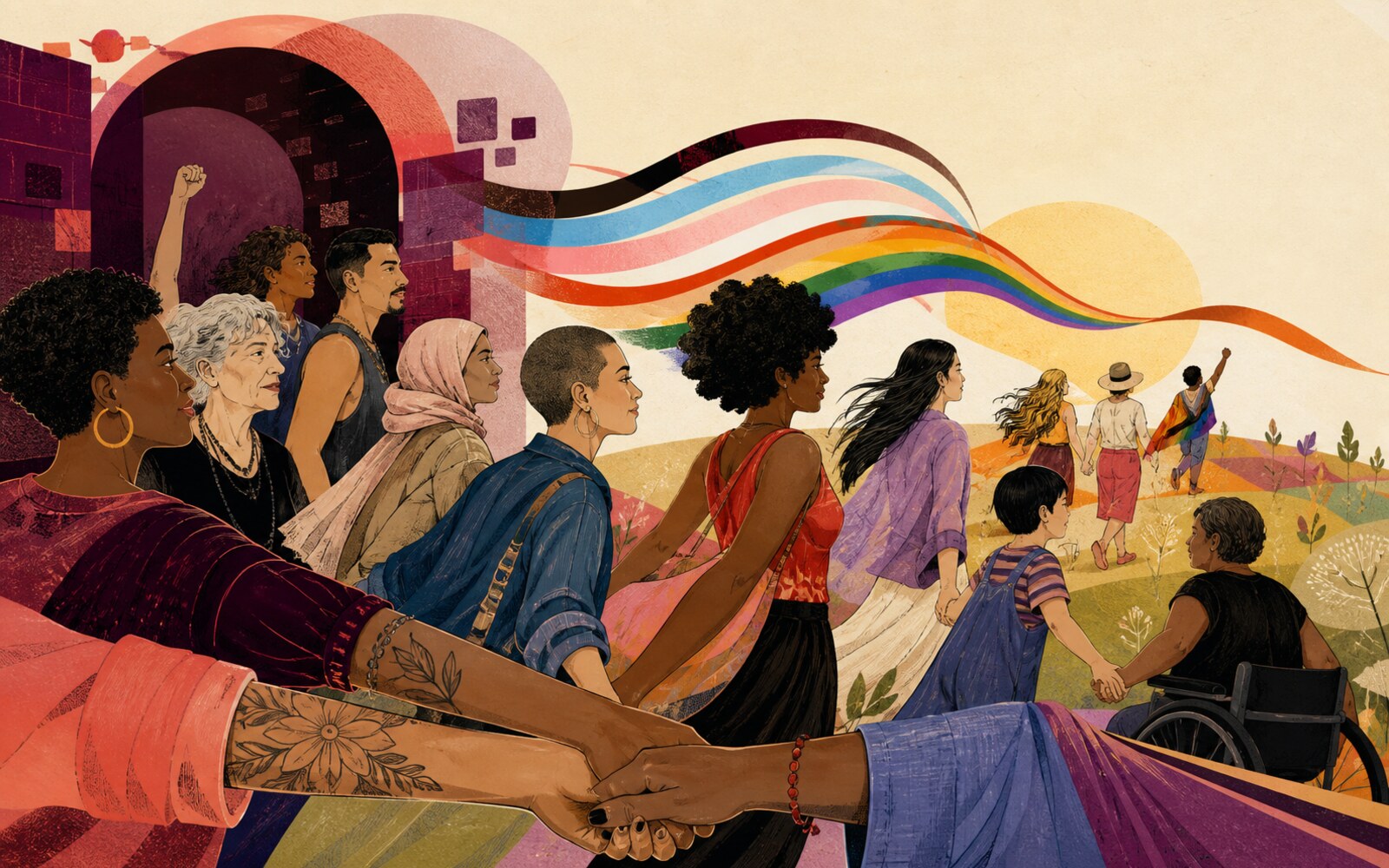
Every revolution begins with a body that refuses to retreat. In the early hours of June 28, 1969, in a sweltering bar in Greenwich Village, it was the city’s most exposed bodies — travestis, drag queens, lesbians, and poor young men — that said no to the ritual of humiliation the police had been repeating for years. From the heat of that night came the contemporary movement for LGBTQIAPN+ rights and, with it, the conviction that runs through this essay: the dignity of sexual and gender minorities was wrested by force from the inertia of institutions, and every year of delay had its price, inscribed first on the body and, as I will try to show, also in economics and in welfare analysis.
I write as an observer, and I want to bring together languages that rarely meet: the language of verse, and that of models, data, and evidence. Whitman dreamed of inseparable cities, with their arms about each other’s necks, by the love of comrades. Economic theory, in its drier idiom, says something that rhymes with that dream: societies that embrace their own flourish, and those that cast out part of themselves wither. The moral dimension of equality remains sovereign, and nothing that follows seeks to reduce it to calculation. I argue only that, even from the cold standpoint of efficiency, exclusion and discrimination carry a high price for society.
A chronology that does not believe in straight lines
The progress of rights around the world refuses the comfort of triumphal marches. The American Psychiatric Association struck homosexuality from its catalogue of illnesses in 1973; the World Health Organization did so only on May 17, 1990, the date now observed as the International Day Against Homophobia, Biphobia, and Transphobia. The Netherlands celebrated the first same-sex marriage in 2001, and the United States took another 14 years to get there, in 2015, with Obergefell v. Hodges. India decriminalized same-sex desire in 2018, burying a law it had inherited from the British Empire.
It would be naive to read this sequence as a staircase that only goes up. More than sixty countries still treat love between people of the same sex as a crime, and in some of them the penalty is death. Even mature democracies are now living through a wave of legislative setbacks, aimed with particular fury at trans people. The history of rights is less like a staircase than like the tide: it advances, retreats, and advances again under the moon. This process has to be understood as nonlinear and, at times, stationary.
The Brazilian picture
Brazil’s trajectory has its own paradox. Unlike much of the West, the country decriminalized sodomy early, in the Criminal Code of the Empire of 1830, and never wrote that crime back into law under the Republic. The law fell silent, but persecution found other mouths in different guises: medical stigma, violence on street corners, and the closed door of employment. So it went for almost two centuries, with almost no meaningful progress.
Formal advances came late and, almost always, through the courts. In 2011, the Supreme Federal Court recognized civil unions between people of the same sex (STF, 2011); in 2013, Resolution No. 175 of the National Council of Justice opened civil registries to same-sex civil marriage (CNJ, 2013); in 2018, the Court guaranteed trans people the right to change their name and gender on official records without surgery or a medical report (STF, 2018); and in 2019, it placed homophobia and transphobia on the same legal footing as racism (STF, 2019).
There is a fragility in this achievement that should be named. Rights that rest on the interpretation of eleven justices, without the backing of a parliamentary majority, live under the constant threat of being undone, and that precariousness is itself a low-intensity form of violence, legal and economic, against millions of people.
While case law climbed the courthouse steps, out in the streets minorities of every kind went on being killed in great numbers. For the seventeenth consecutive year, Brazil is the country that murders the most trans people in the world (ANTRA, 2025). In 2024, the National Association of Travestis and Transsexuals counted 122 bodies, slightly fewer than in 2023 but still close to the annual average of about 125 deaths (ANTRA, 2025). Life expectancy for this population is around 35 years, compared with 73 and 79 for cisgender men and women; 78% of the victims were Black, which shows that much of this violence has a color and a class, and carries with it a large share of adjacent prejudices (ANTRA, 2025).
The arithmetic of waste
The economic argument has classical roots. In 1957, in The Economics of Discrimination, Gary Becker showed that prejudice exacts a toll from those who practice it and from the whole economy. An employer who turns down a competent worker out of aversion to whom that person loves or how they identify gives up productivity, and when that gesture becomes a collective habit, the whole country starts producing less than it could. In dry, technical language, prejudice undervalues human capital and, as a result, keeps a society from reaching its highest level of wealth.
Part of this intuition has been measured. In a study for the World Bank, the economist M. V. Lee Badgett (2014) calculated that the exclusion of LGBTQIAPN+ people in India, at work, at school, and in healthcare, took away up to 1.7% of GDP each year. In a broader study covering 132 countries between 1966 and 2011, Badgett, Waaldijk, and Rodgers (2019) found a robust link between rights and prosperity: for each step gained on a scale of eight rights, output per person rose by about two thousand dollars on average. This is a relationship of mutual causality: richer economies tend to recognize more rights, and the advance of those rights also drives economic development. In her most recent assessment, Badgett (2020) put forward a conservative estimate: homophobia and transphobia cost a nation at least 1% of its output, an estimate that matters a great deal not only politically but also for wealth and for the analysis of regional inequality.
The channels through which this loss drains away are visible and measurable. In the labor market, exclusion pushes output far below what is possible, and in Brazil, according to a survey by the Business and LGBTQIAPN+ Rights Forum reported by ANTRA (2025), trans people hold only 0.38% of formal jobs, a gulf that pushes most of them into informal work or sex work, often the only places that do not turn them away at the door. In healthcare, stigma makes people ill, overloads the public system, and cuts years off productive lives; a population that barely reaches 35 has its economic future cut in half. In education, harassment, dropping out, and family abandonment interrupt people’s training and impoverish the country’s human capital. And there is innovation: since Florida (2002), we have known that cities open to diversity attract talent and create the new, so places that drive people out for who they are end up driving out, along with them, part of the intelligence that powers the knowledge economy.
Finally, we should lift our eyes from the data. Sen (2000) taught us to see development as the expansion of the real freedoms each person has to live the life they have reason to value. In that light, denying someone work, health, safety, and recognition is a corrosive subtraction from development in the most exact sense economics gives the word, well beyond the ethical wound it opens. There is value in these rights, and part of it belongs to society itself, even if society does not yet fully know it.
Martyrs
Percentages have faces; victims have names, stories, families, achievements, and invaluable contributions to the world. In 1952, a British court convicted Alan Turing, the mathematician who had broken the codes of the “Enigma” machine and helped shorten the Second World War, the man whose ideas founded computer science and, with it, much of the economy we live in today. His crime, in the eyes of the law, was loving another man. The sentence imposed was chemical castration. Two years later, at 41, Turing was dead, the victim of a poison rooted in the British atmosphere that drove him to take his own life. The civilization that prospers on the machines he imagined treated their inventor as a criminal and destroyed him, and no model or dataset can measure — or, strictly speaking, perhaps it can — what is lost when a mind like that is silenced halfway along its path.
Turing does not stand alone in this accounting. Oscar Wilde, the most dazzling playwright of his generation, left two years of hard labor in Reading prison with his health and his work in ruins, and died in exile in 1900. Federico García Lorca, a towering voice of Spanish poetry, was shot in 1936, in the first days of the Civil War, and his homosexuality was among the hatreds that armed the hand of those who killed him. Bayard Rustin, the strategist who designed the 1963 March on Washington alongside Martin Luther King, was pushed into the shadows of the civil rights movement itself for being a gay man, and was only recognized decades after his death. And in Brazil, with every name ANTRA adds to its dossier, the same act is repeated on a smaller scale: a productive life cut short before its time. The list could go on for pages and would still hold only the names history has kept; the anonymous ones, the countless teachers, workers, artists, and scientists whom prejudice erased before their first flowering, fit into no statistic at all.
The love of comrades
It must be said plainly, so that there is no mistake. The economic argument plays a supporting role, propping up from the outside what morality already holds up from within, and morality matters far more than any technical or quantitative perspective. The dignity of an LGBTQIAPN+ person does not depend on how profitable they are, and the right to exist is not subject to audit. Those who submit this discussion solely to the appeal of economic data and discard what matters most, civil rights, have already lost what is essential: their humanity and their capacity for love and empathy toward others.
Even so, it is worth stating, for the sake of the fight. For decades, opponents of equality sold inclusion as a luxury, a whim of urban elites, a dispensable item in the so-called serious economy. The numbers turn that argument inside out. What is costly, what is burdensome, what truly impoverishes a country is the act of excluding. Defending discrimination, besides being abhorrent, sabotages social development, the national project, and the future of all of us and of our children. Without knowing it, an intolerant person, within their inability to be rational and to love, works against their own assets in the name of a pathetic defense of traditional values whose structure was never a model for any functioning society. The result? A nation poorer, less productive, and less creative than it could be.
Pride was born of a riot because dignity had been denied for too long, and today we know that this denial never came free: it was paid for in interrupted lives, in stolen years, in wasted talent, in ideas that never saw the light of day. Recognizing rights, punishing violence, and guaranteeing work and healthcare are, in the end, a society investing in itself, reclaiming the frontier that fear had confiscated and, above all, giving individuals their rightful place: the whole world. A world in which to feel, to love, to be frustrated, to overcome, and to achieve, where part of that experience lies not in the struggle to exist but in growing as a person. Whitman imagined cities with their arms about each other’s necks, by the love of comrades. Economics, prosaic as ever, only confirms what poetry had already foretold: no city flourishes by casting out its own. May the next June 28 find us with fewer names on the list of the dead, with more of those who are fighting today for their right to be different writing their own stories, and with a chance to enjoy the reason and the poetry of living, once living has stopped being an act of protest. There is no verse, and no number, more beautiful than that.
I dedicate this essay to everyone who, because of prejudice, lost lives, dreams, families, smiles, and embraces.
References
ASSOCIAÇÃO NACIONAL DE TRAVESTIS E TRANSEXUAIS (ANTRA). Dossiê: assassinatos e violências contra travestis e transexuais brasileiras em 2024. Brasília, DF: ANTRA, 2025.
BADGETT, M. V. Lee. The economic cost of stigma and the exclusion of LGBT people: a case study of India. Washington, DC: World Bank, 2014.
BADGETT, M. V. Lee. The economic case for LGBT equality: why fair and equal treatment benefits us all. Boston: Beacon Press, 2020.
BADGETT, M. V. Lee; WAALDIJK, Kees; RODGERS, Yana van der Meulen. The relationship between LGBT inclusion and economic development: macro-level evidence. World Development, v. 120, p. 1-14, 2019.
BECKER, Gary S. The economics of discrimination. Chicago: University of Chicago Press, 1957.
BRASIL. Supremo Tribunal Federal. Ação Direta de Inconstitucionalidade nº 4.277 and Arguição de Descumprimento de Preceito Fundamental nº 132. Reporting Justice: Ayres Britto. Brasília, DF, May 5, 2011.
BRASIL. Conselho Nacional de Justiça. Resolução nº 175, May 14, 2013. Brasília, DF: CNJ, 2013.
BRASIL. Supremo Tribunal Federal. Ação Direta de Inconstitucionalidade nº 4.275. Reporting Justice: Marco Aurélio. Brasília, DF, Mar. 1, 2018.
BRASIL. Supremo Tribunal Federal. Ação Direta de Inconstitucionalidade por Omissão nº 26. Reporting Justice: Celso de Mello. Brasília, DF, June 13, 2019.
FLORIDA, Richard. The rise of the creative class: and how it is transforming work, leisure, community and everyday life. New York: Basic Books, 2002.
SEN, Amartya. Desenvolvimento como liberdade. Translated by Laura Teixeira Motta. São Paulo: Companhia das Letras, 2000.
WHITMAN, Walt. Leaves of grass. Philadelphia: David McKay, 1891-1892.
Originally published on José Oliveira’s Substack (in Portuguese) ↗