
Why did economists fail to predict the 2008 crisis? Simple as it is to state, the question carries a deep discomfort for the profession. The dominant macroeconomic models of the time, especially New Keynesian dynamic stochastic general equilibrium (DSGE) models (still grounded, however, in the microfoundations of the standard classical model, such as representative agents, a linear equilibrium path, and the like), which since Kydland and Prescott (1982) had become the central paradigm of quantitative macroeconomics, ran with full computing power, a vast accumulated literature, and the backing of the world’s leading academic and economic-policy institutions. And yet, when the global financial system began to come apart, most economists were caught by surprise. In an analysis published soon after the crisis, Colander et al. (2009) argued that this failure was not an isolated accident but the symptom of a structural limitation of conventional models: by privileging the elegance of equilibrium and analytical tractability, these models left out, by design, the mechanisms through which local disturbances propagate and amplify into systemic collapse. The question, then, is an econometric one, but not only that. It is a question of how to model an inherently complex system.
When the whole does not fit in the sum of its parts
Before any economic application, the concept of a complex system has deep roots in physics and biology. In 1972, the physicist Philip Anderson published in Science an essay that would become one of the founding texts of the field: "More is Different". Its central argument was apparently simple, but its consequences were vast: knowing the laws that govern the individual constituents of a system is not enough to understand the behavior of the system as a whole, because at each level of complexity entirely new properties appear that cannot be reduced to the laws of the level below (Anderson, 1972). Psychology is not applied biology, biology is not applied chemistry, and, as the 2008 crisis made clear, macroeconomics is not simply the sum of the individual decisions of consumers and firms. This principle, which Anderson formulated for condensed-matter physics, is what complex-systems theory would turn into an interdisciplinary research program over the following decades.
Complex systems, then, are those made up of many interacting elements whose collective behavior cannot be deduced directly from the individual properties of their components (Mitchell, 2009). Complexity, in this technical sense, is not a synonym for complication: a system can operate according to quite simple microscopic rules and still generate surprising macroscopic patterns that are nonlinear and sensitive to initial conditions. This phenomenon is called emergence, and it is present in systems as different as ant colonies, biological neural networks, ecosystems, and market economies. What connects them is not their physical substrate but the structure of their interactions: many heterogeneous agents continuously adapting to an environment that is itself the product of their collective actions. In his seminal work on complex adaptive systems, Holland (1995) identified some recurring properties of these systems, among them nonlinearity, information flows, and diversity among agents, as necessary conditions for the emergence of collective behavior that no individual component could produce on its own. For Holland, the most characteristic trait of these systems is precisely the impossibility of predicting aggregate behavior from an analysis of their parts, which calls for analytical tools radically different from those of classical science.
The price of elegance
It is in this context that complex-systems theory naturally meets macroeconomics. Conventional macroeconomics, at least in the tradition of representative-agent DSGE models, responds to the challenge of aggregating individual behavior through an elegant abstraction: firms, consumers, and workers are synthesized into a single agent that maximizes utility over time, and equilibrium emerges from that agent’s optimization condition under well-defined constraints (Kydland; Prescott, 1982). The analytical apparatus is powerful, the microfoundations are rigorous, and the models are tractable. The price of this elegance, however, is the suppression of heterogeneity and of local interactions among agents, precisely the channels through which, as Arthur (2014) argues, the economy continuously reconfigures itself in response to the decisions of the agents who make it up.
Agent-based models
One of the tools complex-systems theory offers to overcome this limitation is the agent-based model (ABM). In pioneering work that would become a founding reference in the field, Epstein and Axtell (1996) showed that complex social and economic behaviors, such as the formation of markets and income inequality, can emerge spontaneously from populations of simple agents interacting according to local rules, with no equilibrium imposed from outside the model. In an ABM, multiple heterogeneous agents interact with one another and with their environment according to individual rules of behavior, and the macroeconomic outcome emerges from these decentralized interactions, just as order emerges in the insect colonies described by Mitchell (2009): no ant knows the colony’s plan, and yet the colony works. Along these lines, Farmer and Foley (2009) argued that ABMs offer a framework able to capture the network effects, heterogeneity, and nonlinear feedbacks that conventional models systematically ignore, making them a more realistic instrument for analyzing financial instability and evaluating economic policy under high uncertainty.
Local shocks, aggregate effects
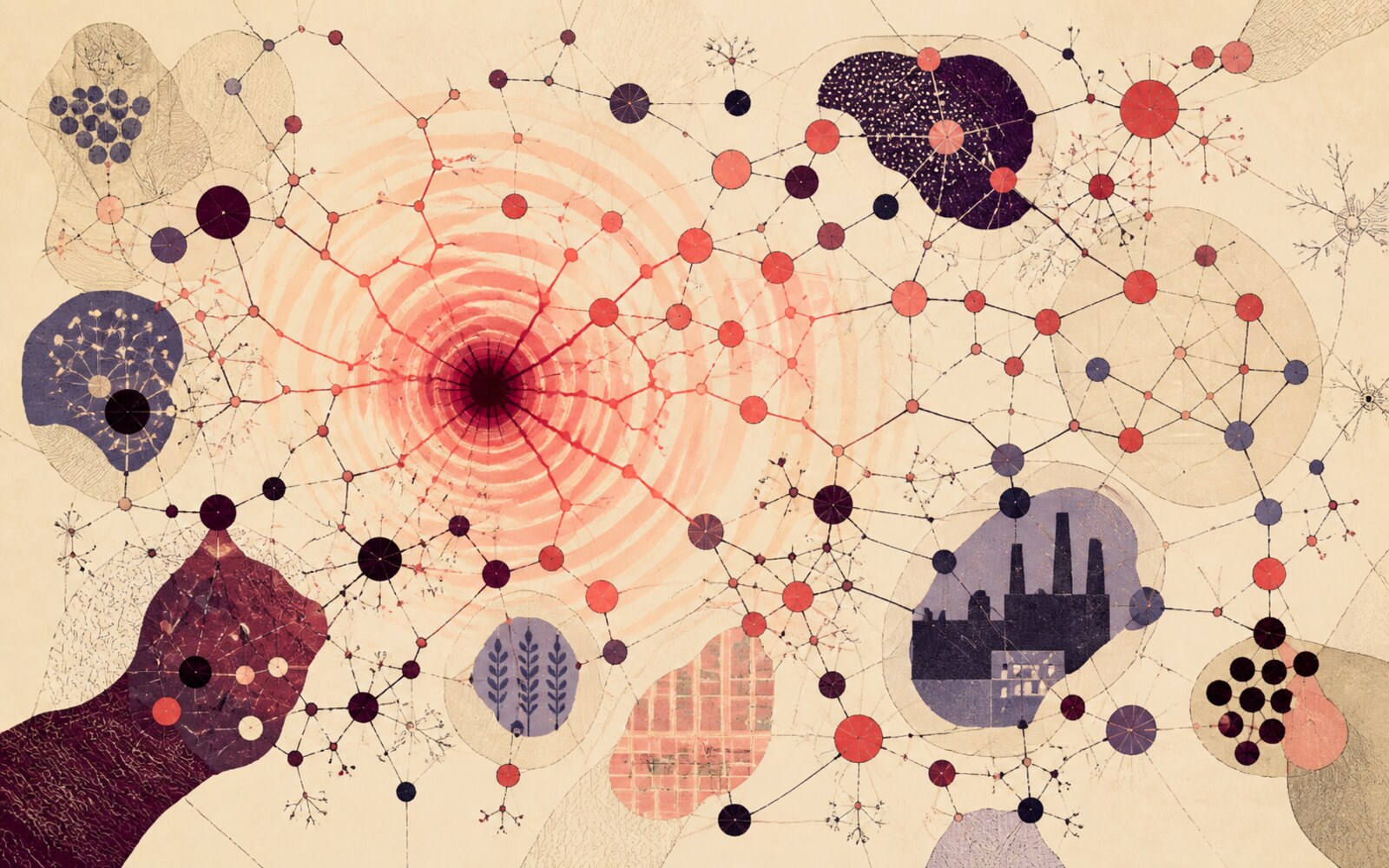
The second major contribution of complex systems to macroeconomics concerns the origin of aggregate fluctuations. The classic question of business-cycle theory is why apparently small, localized shocks can produce such broad and synchronized recessions. The conventional answer, introduced by Kydland and Prescott (1982) in real business-cycle models and later incorporated into New Keynesian models, relies on aggregate productivity shocks or on nominal and real frictions that propagate symmetrically through the economy. The network approach, within the complex-systems paradigm, offers a complementary and mathematically rigorous answer: idiosyncratic sectoral shocks can generate significant aggregate fluctuations when the economy has an asymmetric input-output structure in which certain sectors occupy central positions in the production network (Acemoglu et al., 2012). In a paper published in Econometrica, Acemoglu et al. (2012) formalized this mechanism, showing that the rate at which aggregate volatility decays is determined by the topology of the network of intersectoral links. In other words, if a few sectors act as critical suppliers to a long production chain, a localized shock at those nodes cascades through the rest of the economy, producing contractions that conventional partial-equilibrium models would struggle to explain and anticipate, and that only become intelligible when the economy is treated as what it actually is: a complex system.
Heterogeneity and HANK models
What unites these two contributions is a view of the economy as a system in which the structure of interactions matters as much as individual incentives. Adopting this perspective does not mean abandoning the analytical rigor of conventional economic theory, nor rejecting the microfoundations that give the discipline its explanatory power. It means, rather, recognizing that certain macroeconomic phenomena, among them financial crises, business cycles, and market concentration, emerge from dynamics that representative-agent equilibrium models capture only incompletely, and that complementary tools are available to anyone willing to use them. As Anderson (1972) showed for physics more than fifty years ago: at each new level of complexity, entirely new laws have to be built. By incorporating complex systems, macroeconomics is doing exactly that. DSGE models have since been extensively updated to include heterogeneity among agents, in direct response to the criticisms that the 2008 crisis made impossible to ignore. The most recent generation of these models, known as HANK (Heterogeneous Agent New Keynesian) models, combines the conventional New Keynesian structure with realistic distributions of income and wealth among agents, dropping the representative-agent assumption in favor of an economy populated by households with different marginal propensities to consume, different levels of liquidity, and different degrees of exposure to income shocks. In an article published in the American Economic Review, Kaplan, Moll, and Violante (2018) showed that in these models the indirect effects of monetary policy, operating through aggregate demand and the labor market, far exceed the direct intertemporal-substitution effects that dominate representative-agent models, a conclusion that only becomes possible when the heterogeneity of agents is taken seriously. DSGE was not discarded. Quite the opposite: it was updated and led to grow in the direction that complex systems had always pointed to, namely that the structure of heterogeneity matters, and that ignoring it is not a harmless simplification but a distortion of the very mechanism one is trying to model. Neoclassical economics, then, by bringing the theoretical structure of complex systems into its modeling, has become sounder and more effective at forecasting, refining its microfoundations and adding a greater degree of realism to the final model. Economics is grateful!
References
ACEMOGLU, Daron; CARVALHO, Vasco M.; OZDAGLAR, Asuman; TAHBAZ-SALEHI, Alireza. The network origins of aggregate fluctuations. Econometrica, v. 80, n. 5, p. 1977-2016, Sept. 2012.
ANDERSON, Philip W. More is different: broken symmetry and the nature of the hierarchical structure of science. Science, v. 177, n. 4047, p. 393-396, Aug. 1972.
ARTHUR, W. Brian. Complexity and the Economy. Oxford: Oxford University Press, 2014.
COLANDER, David; FÖLLMER, Hans; HAAS, Armin; GOLDBERG, Michael; JUSELIUS, Katarina; KIRMAN, Alan; LUX, Thomas; SLOTH, Birgitte. The financial crisis and the systemic failure of the economics profession. Critical Review, v. 21, n. 2-3, p. 249-267, 2009.
EPSTEIN, Joshua M.; AXTELL, Robert L. Growing Artificial Societies: Social Science from the Bottom Up. Cambridge: MIT Press, 1996.
FARMER, J. Doyne; FOLEY, Duncan. The economy needs agent-based modelling. Nature, v. 460, n. 7256, p. 685-686, Aug. 2009.
HOLLAND, John H. Hidden Order: How Adaptation Builds Complexity. Reading: Addison-Wesley, 1995.
KYDLAND, Finn E.; PRESCOTT, Edward C. Time to build and aggregate fluctuations. Econometrica, v. 50, n. 6, p. 1345-1370, Nov. 1982.
MITCHELL, Melanie. Complexity: A Guided Tour. New York: Oxford University Press, 2009.
KAPLAN, Greg; MOLL, Benjamin; VIOLANTE, Giovanni L. Monetary policy according to HANK. American Economic Review, v. 108, n. 3, p. 697-743, Mar. 2018.